A new heat pump can’t fix old ducts
A heat pump moves about 400 cubic feet of air per minute for each ton. If the ducts can’t carry that, the new system runs loud, wears its blower and never reaches its rating.
Bluffline Memphis Heat Pumps fixes ducts as part of heat pump jobs across Memphis, and we measure before we quote.
What bad ducts feel like
- Rooms at the end of the run that never reach the setpoint.
- A return grille that whistles or pulls the filter tight against it.
- Sweating ducts dripping onto a crawlspace vapor barrier in summer.
- A house that stays damp even with a new system.
- Higher bills with no change in how you use the house.
Static pressure: the number that decides
Total external static pressure is the resistance the blower pushes against, measured in inches of water column. Most residential blowers are built for about 0.5.
On the first visit we drill two small test ports and take the reading with the system running. That number tells us whether the ducts can carry a new heat pump’s air.
Reading the result
- Around 0.5: the ducts are fine for the new system.
- 0.6 to 0.8: something restricts the air, often the return or the filter rack.
- Above 0.8: the blower is fighting the ducts, and a new heat pump on them will be noisy and short of air.
You get the number before and after the work, so the improvement is measured, not promised.
Returns: the usual bottleneck
Many Memphis houses have one central return, sized for a smaller or older system. A heat pump that needs 1,200 cubic feet per minute can’t pull it through one 14 inch grille.
The fix is a second return or a larger one, boxed and sealed, in a hallway or a bedroom that never cools. Where bedroom doors stay closed, a jumper duct or transfer grille lets the air get back.
Crawlspace ducts in a humid town
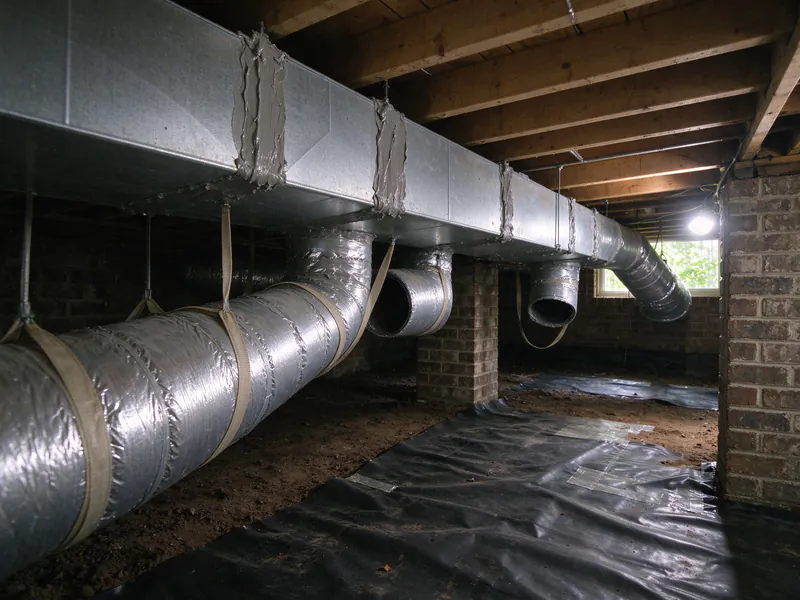
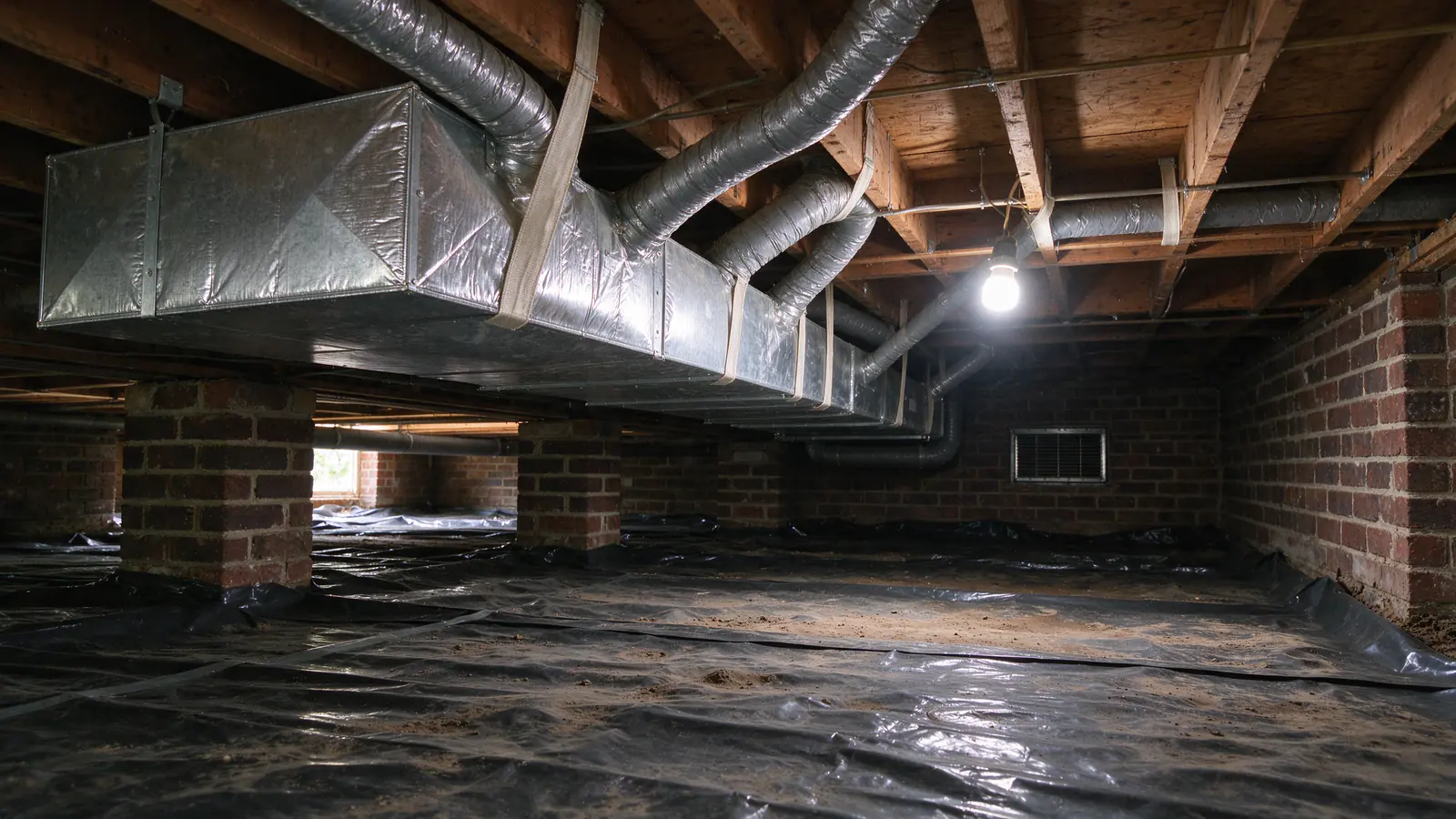
Crawlspace ducts sit in humid air under the house. When the insulation is torn or thin, cold supply ducts sweat in summer, water drips onto the vapor barrier and the insulation gets wetter.
What we fix under the floor:
- Trunk seams sealed with mastic, not cloth tape.
- Branch connections that have come loose from the trunk.
- Insulation rewrapped to at least R-8 where it is torn, wet or missing.
- Straps and hangers so runs don’t sag into the dirt.
Crawl space ductwork explains why Memphis crawlspaces are hard on ducts.
Attic ducts and flex
Attic ducts face the opposite problem: summer attic air above 120 degrees. Flex duct sags between supports and crushes where it crosses trusses, and every sag and kink cuts airflow.
We replace crushed runs, hang the new ones on straps at the right spacing and seal every connection to the plenum and the boots.
When to replace instead of repair
- Flex that is crushed, torn or collapsing.
- Insulation that is wet or has fallen off.
- A plenum rusted or too small for the new air handler.
- Runs sized for a much smaller system.
Leaks you can’t see
Static pressure tells you whether air can get through. It doesn’t tell you how much leaks out on the way.
In a crawlspace or attic, leaking supply air cools the space under the house instead of the bedroom, and a leaking return pulls damp crawlspace or hot attic air into the system.
How we find them
- A look at every reachable seam, boot and plenum connection with the system running.
- Temperature at the registers, compared room to room; a cold trunk and a warm bedroom register point to a leak between them.
- A duct leakage test where the owner wants a number or a rebate requires one.
Where they hide
The usual places are the plenum collar at the air handler, the return box behind the filter grille, and the boots where branches meet the floor or ceiling. All of them are cheap to seal once they are found.
Older houses, older ducts
Ducts age with the house.
A 1990s ranch in Bartlett is often on its second system and its original ducts, and a 1960s house in Memphis may have ducts that were extended or patched for decades. Neither is a reason to replace everything; both are reasons to measure.
Sizing the ducts with the system
Ducts and equipment are sized together. A load calculation sets the heat pump’s size, and the duct check confirms the ducts can carry its air.
A unit that is too big for the house is also too big for the ducts, so getting the size right often relieves a tight return.
Related reading
The sizing guide covers both, and the humidity guide explains why airflow matters for moisture.
What duct work costs
Bluffline’s typical range for duct repair and sealing done with an install is $800 to $3,500. Your written estimate after the visit sets the price.
The duct line is separate from the equipment, so you can see exactly what it adds. Replacing many runs or a whole trunk is priced per house.
Rebate
TVA EnergyRight pays $300 for qualifying duct sealing and insulation, done by a participating contractor, for MLGW customers. The cost page covers every range.
Before or with the heat pump?
With, in most cases. Doing the duct work on install day means one visit, one permit and a static reading that proves the whole system works together.
If your heat pump is recent and only the ducts are failing, duct work can stand alone. If the system is due, see heat pump replacement or air handler replacement.
Ducted heat pump or mini split?
Where a room has no duct at all, such as a converted garage, a ductless system can serve it. That is a different trade from ours. The ducted versus mini split guide explains the choice.