Your heat pump is failing and you want the next one to last
When the compressor goes, the coil leaks or the repair bills keep climbing on a 15-year-old unit, replacement is usually the better money. Bluffline Memphis Heat Pumps replaces heat pumps across Memphis and the towns around it.
We start by working out what the house needs now, not what was installed in 2008.
What usually ends a heat pump here
- Compressor failure on a unit past about 15 years.
- A leaking coil, indoor or outdoor, especially on older R-22 systems.
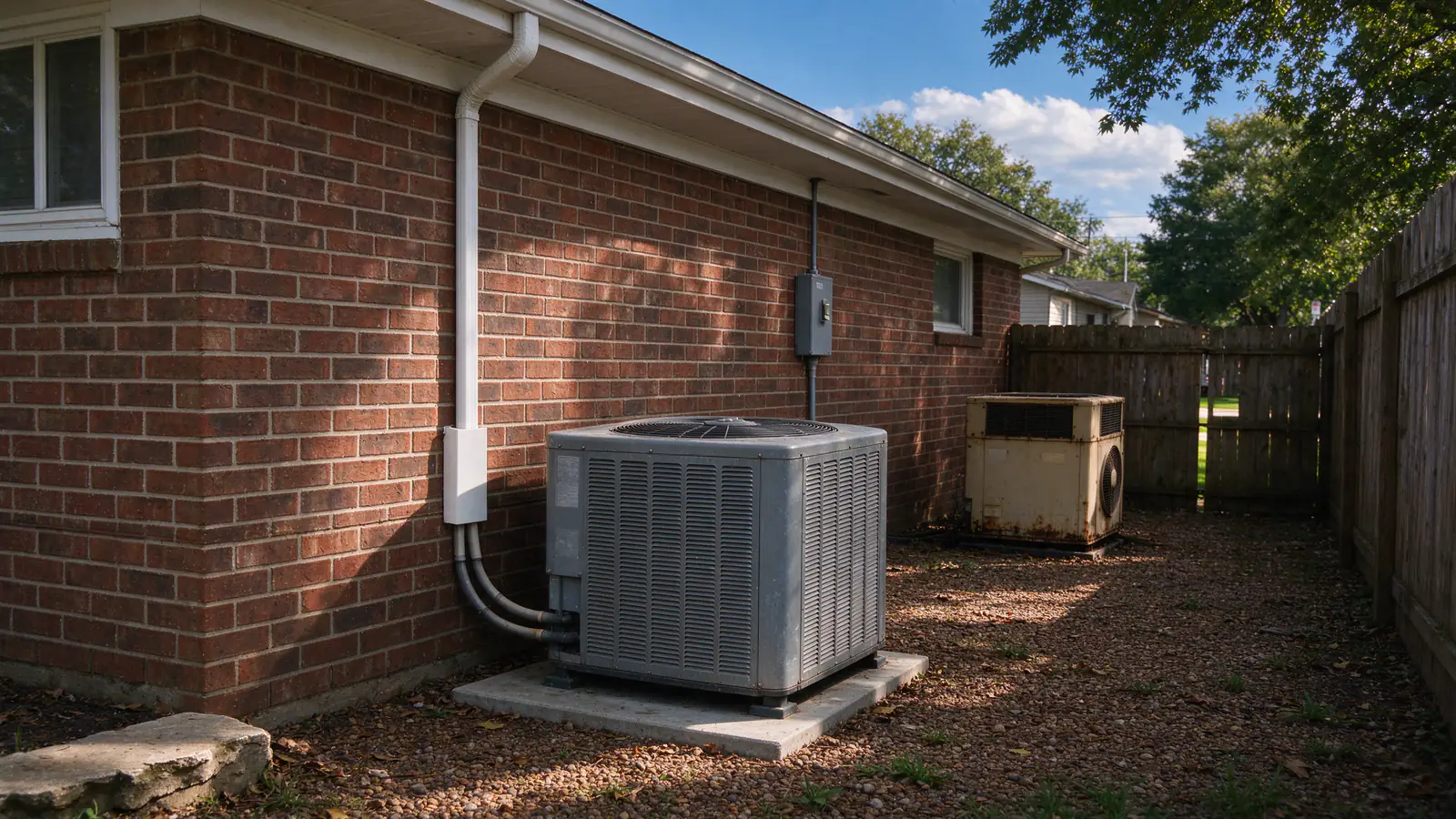
- Rust and fin damage on outdoor coils that sat in wet leaves or against a dryer vent.
- Repeated capacitor and contactor failures, which are cheap alone but add up.
If the repair is small and the unit is young, we tell you that. The repair or replace guide walks through the math.
Why we don’t copy the old nameplate
Many Memphis houses were fitted with more capacity than they needed, and since then plenty have gained replacement windows, attic insulation or a new roof. Copying the old tonnage carries the old mistake forward.
We run a load calculation for Shelby County’s design conditions, 95 degrees in summer and 20 degrees in winter. It uses the house itself: square footage, windows, insulation, orientation and the ducts.
What oversizing does in a Memphis summer
A heat pump that is too big cools the air fast and shuts off before it has pulled much water out of it. The house reaches 72 degrees and still feels sticky. Short cycles also wear the compressor. The sizing guide explains the method.
Both halves have to match
A heat pump is two pieces of equipment that are rated as a pair. The outdoor unit and the indoor coil or air handler have to be a matched combination, listed together, for the system to reach its SEER2 and HSPF2 numbers.
When the indoor half can stay
If your air handler is recent, uses the right refrigerant and the maker lists it as a match for the new outdoor unit, we can keep it and replace only the outside. Bluffline’s typical range for an outdoor unit only is $4,500 to $9,000.
When it has to go
An old air handler, a rusted pan, a leaking coil or an R-22 system means the whole system changes. Bluffline’s typical range for a whole-home ducted system is $8,000 to $16,000. Your written estimate after the visit sets the price.
The ducts and the line set
A new heat pump moves about 400 cubic feet of air per minute for each ton. If the ducts can’t carry it, the new system runs loud and short of air.
On the first visit we take a static pressure reading. If the number is high, the estimate shows the fix as its own line, usually a bigger return or sealed trunk seams, priced to be done the same day. Heat pump ductwork covers what that work involves.
Reusing the line set
The two copper lines that join the halves can often stay. We reuse them when they are the right size, hold pressure and did not carry R-22. Otherwise we replace them, and the estimate says which and why.
What the replacement day looks like
Most outdoor-unit-only jobs take one day. A whole system takes one or two.
- Pull the mechanical permit for your town.
- Recover the old refrigerant and remove the old equipment.
- Set the new outdoor unit on a level, raised pad and the air handler or coil inside.
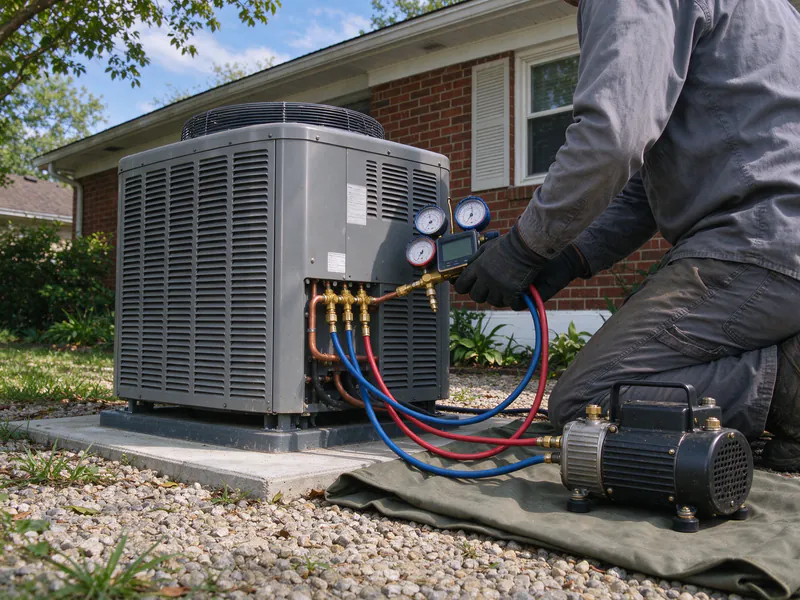
- Braze the line set under nitrogen, pressure-test it and pull a vacuum below 500 microns.
- Charge by weight and check subcooling against the maker’s numbers.
- Set the thermostat so backup strips stay off above the temperature where the heat pump can carry the house.
- Test cooling, heating, defrost and the backup, and leave the readings with you.
The commissioning checklist lists every reading and what it should be.
Efficiency tiers and the TVA rebate
Most Memphis homes are on MLGW, a TVA power company. TVA EnergyRight pays $500 for a qualifying heat pump at 15 SEER2 and $800 at 17 SEER2.
The equipment has to be installed by a participating contractor in TVA’s Quality Contractor Network. The TVA rebate guide covers the rules, and the estimate shows which tier each option falls in.
Does the higher tier pay back?
Higher tiers pay back fastest in houses that run the AC hard. On poor ducts the extra efficiency is partly lost, so we fix airflow before recommending a higher tier. SEER2 and HSPF2 explained covers the ratings.
Single-stage, two-stage or variable speed
Single-stage units run full speed or off. Two-stage and variable speed heat pumps run slower for longer, which pulls more moisture from the air and evens out rooms. They cost more, and they earn it most in two-story houses and humid bedrooms.
What your written estimate lists
An estimate you can compare against another company’s needs more than a total. Ours lists:
- The load calculation result in tons, next to the size of the old unit.
- Model numbers for both halves, so you can look up the matched rating yourself.
- The SEER2 and HSPF2 ratings and the TVA rebate tier they fall in.
- The line set decision, reuse or replace, with the reason.
- Duct work and electrical work as separate lines, each with its own price.
- The permit and who pulls it.
If two quotes differ by a ton or by a whole duct line, those lines show you why.
Choosing the moment
Replacing a heat pump in spring or fall is easier than in a July heat wave, when supply is tight and every day without cooling hurts.
If your unit is past 15 years and needs a major repair, a written estimate before it fails gives you time to choose.
Signs worth a visit now
- Higher MLGW bills with no change in how you use the house.
- Backup strips running on mild winter days.
- Ice that stays on the outdoor coil long after a defrost cycle.
- Rooms that won’t cool on the hottest afternoons.
The lifespan guide explains how Memphis heat and humidity age a heat pump.