Millington heats with electricity
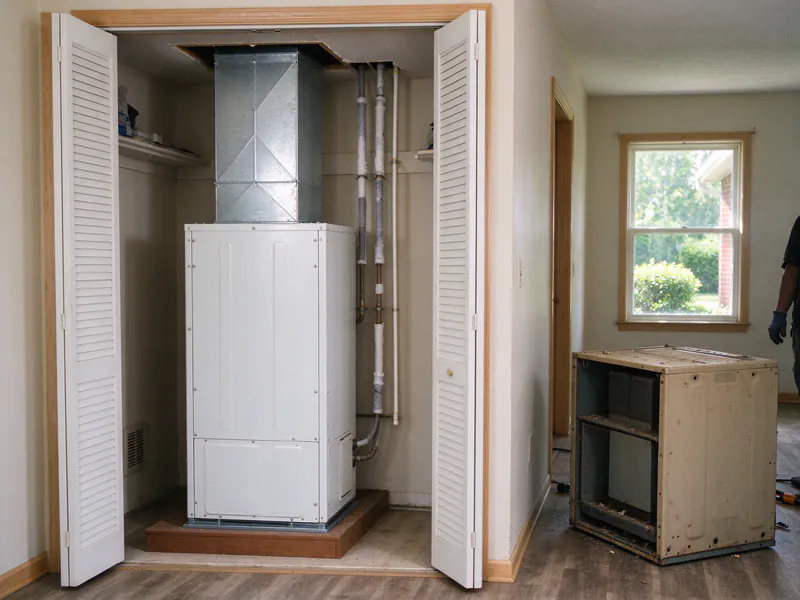
About 65 percent of Millington homes heat with electricity, according to the Census Bureau, the highest share of any town around Memphis. The typical house was built in 1972, and many still have an electric furnace in a hall closet.
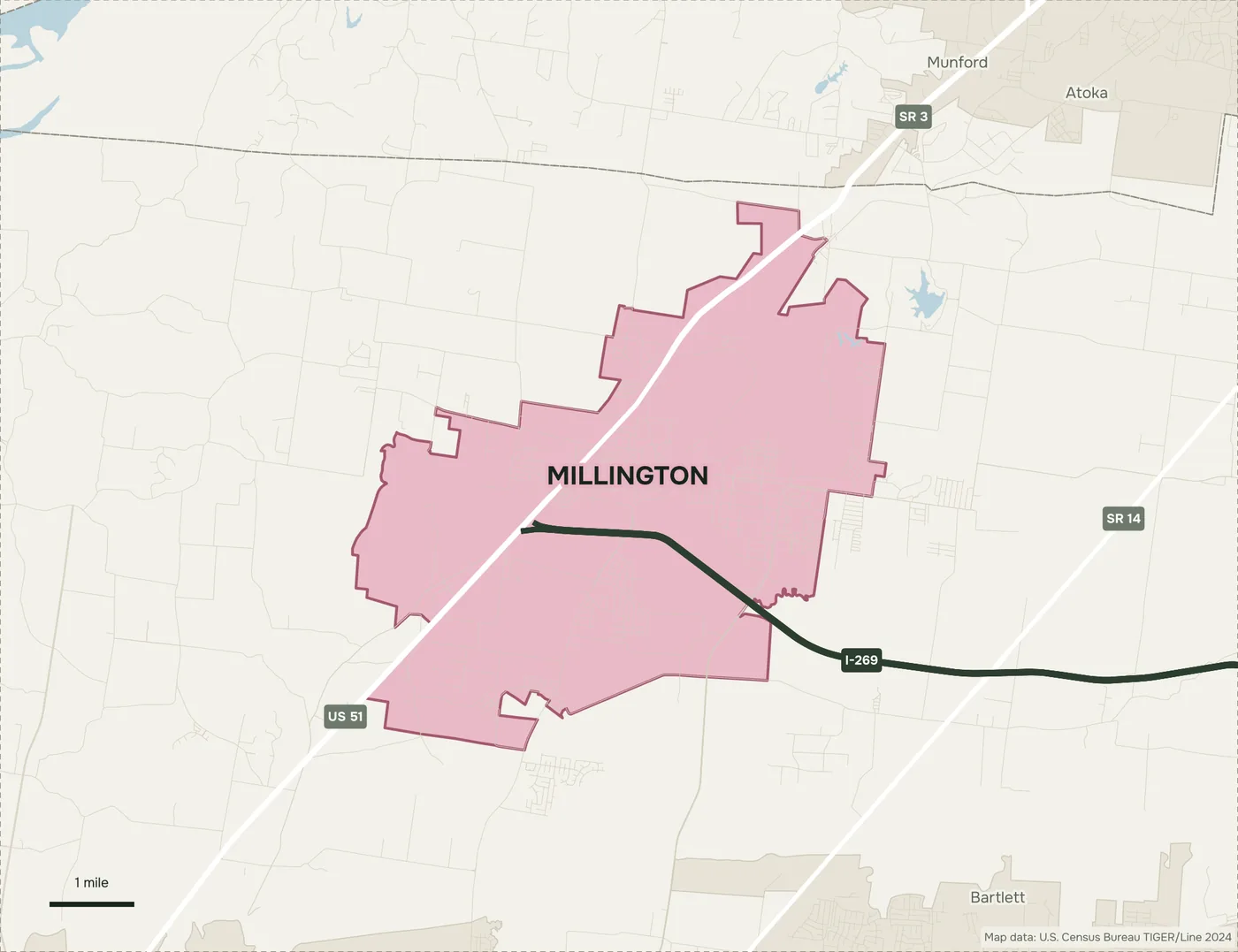
Bluffline Memphis Heat Pumps replaces strip heat with heat pumps across Millington, from Navy Road to Wilkinsville Road. It is the single change that moves a Millington winter bill most.
Why the bill moves so much
A kilowatt-hour through a strip heater comes out as a kilowatt-hour of warmth and no more; a heat pump pulls extra warmth in from outdoors. On MLGW’s rates the gap works out to about $35.80 per million BTU for strips against $10.20 to $14.30 for a heat pump.
What changes in a Millington ranch
The ducts stay. Three things change:
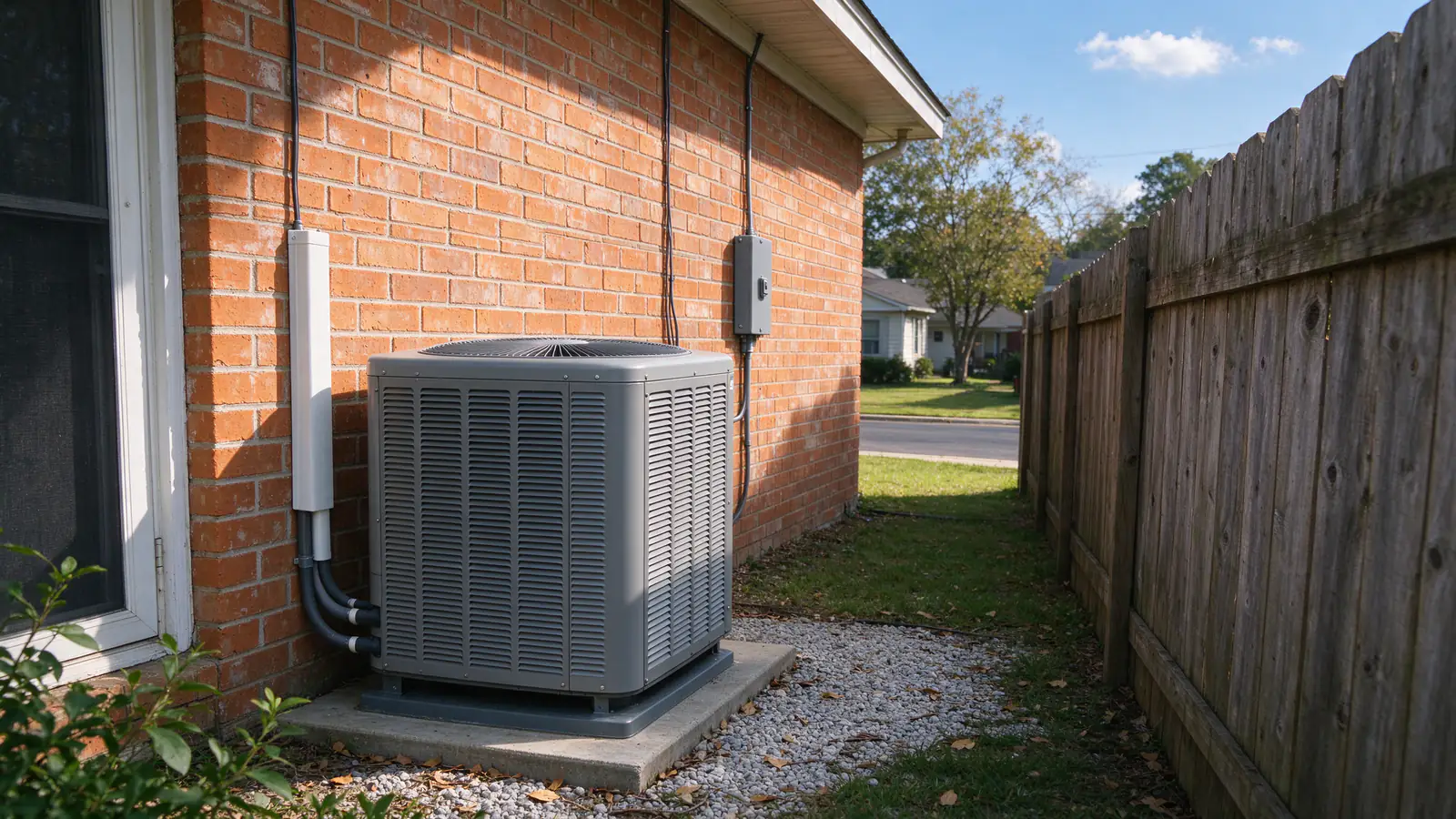
- On the pad out back: the old AC goes and the heat pump goes in its spot.
- Behind the closet doors: the electric furnace comes out and a matched air handler with roughly a third of the old strip capacity goes in.
- In the hallway: a heat pump thermostat, wired to a sensor outdoors.
The electric furnace to heat pump page explains the conversion in detail.
Sizing the strips
A Millington ranch that ran on 15 kW of strips usually needs about 5 kW of backup with a heat pump, set by a load calculation at Shelby County’s 20-degree design temperature. The rest of the time, the heat pump carries the house.
The strip lockout makes the savings
Without an outdoor sensor, the thermostat brings the strips on whenever the house falls behind, even on a 50-degree afternoon. The bill barely moves.
What we set at start-up
- An outdoor sensor, so the thermostat knows the temperature outside.
- A lockout that keeps strips off above about 30 to 35 degrees.
- Recovery settings so a morning warm-up doesn’t call the strips.
The aux and emergency heat guide explains the settings and the emergency switch.
Closets, slabs and old panels
Many Millington ranches sit on slabs with the furnace in a hall closet and the ducts in the attic. Three things get a close look on the visit.
The closet
Millington hall closets from the early 1970s are often shallow, with louvered doors that double as the return. We measure the depth, the door opening and the ceiling height before choosing a cabinet.
The panel
An electric furnace usually sits on a large circuit. The new air handler with smaller strips needs less, and the outdoor unit can often reuse the AC’s circuit. Older panels get a check for capacity and condition. The panel guide explains when work is really needed.
The ducts
Attic ducts from the 1970s may be original. A static pressure reading shows whether they can carry the new system’s air. If not, the fix is a separate line. See heat pump ductwork.
The separate mechanical permit
Millington requires a separate mechanical permit for HVAC work, pulled by a licensed mechanical contractor, with applications through Develop901. MLGW is the only electricity and gas provider in the city.
We file the permit and schedule the inspection. Install day follows the permit.
What it costs in Millington
A strip-heat swap replaces both halves, so it falls in Bluffline’s whole-system range of $8,000 to $16,000. Smaller Millington ranches tend toward the lower half. The other ranges:
| Millington job | Typical range |
|---|---|
| Strip heat out, heat pump and air handler in | $8,000 to $16,000 |
| Heat pump replacing an old heat pump outside only | $4,500 to $9,000 |
| Attic duct sealing or a new return, with an install | $800 to $3,500 |
Your written estimate after the visit sets the price. The cost guide explains what moves it.
TVA rebate
MLGW is a TVA power company, so TVA EnergyRight applies: $500 for a qualifying heat pump at 15 SEER2 and $800 at 17 SEER2, installed by a participating contractor in TVA’s Quality Contractor Network.
Additions, dens and window units
Plenty of Millington houses have grown since 1972: a den off the back, a converted garage, a sunroom.
Some of those rooms were tied into the original ducts with a long branch; others never got ducts and run on a window unit or a space heater.
What we look at
- Long branch runs to added rooms, which often deliver far less air than the room needs.
- Rooms with no duct at all, where a new supply run may or may not reach from the attic.
- The load of the added room, which the old system was never sized for.
Where a room can be ducted, adding it to the load calculation and running a proper supply and return lets the new heat pump carry it. Where it can’t, a ductless system is a separate trade from ours; the ducted versus mini split guide explains the choice.
Buying a house with strip heat
If you’re buying a Millington house with an aging electric furnace, the first winter’s bills will show it quickly.
A written estimate before closing, or before the first cold month, shows what the swap costs and roughly how much of the winter heating bill it removes, so the decision isn’t made in January.
Your first winter on a heat pump
The heat feels different. Strip heat blows air at well over 100 degrees in short bursts; a heat pump delivers air in the 90s for longer stretches. The house reaches the same temperature, more evenly.
On the bill
Compare January with last January, not with December, since cold snaps vary. Reading your MLGW bill after a heat pump shows what to look for.
Gas houses in Millington
About a third of Millington heats with gas. In those houses, a sound furnace and a failing AC usually point to dual fuel, with a heat pump where the AC was.
Nearby
We work across Millington, from Navy Road and downtown to Big Creek and the neighborhoods along Raleigh-Millington Road.
Bartlett to the south has newer houses and its own Code Enforcement office. The Memphis heat pump buying guide covers every step.