Small buildings, open every weekday
Small offices, shops, storefronts and churches across Memphis run on the same kinds of heat pumps as houses, only bigger and often on the roof. The difference is the schedule: the building has to stay open.
Bluffline Memphis Heat Pumps installs commercial heat pumps in small buildings across Memphis and Shelby County, and we plan the work around your hours.
What we work on
- Offices and storefronts of up to a few thousand square feet.
- Shops and showrooms with long open hours.
- Churches and fellowship halls, where loads swing from empty to full in an hour.
- Small medical and professional suites with several zones.
Split system or packaged rooftop unit
Commercial heat pumps come in two forms, and the building usually decides.
Split systems
An outdoor unit on a pad or the roof and an air handler inside, joined by a line set, just as in a house but larger. Splits fit buildings where the ducts start inside, in a mechanical closet, above a ceiling or in an attic.
Packaged rooftop units
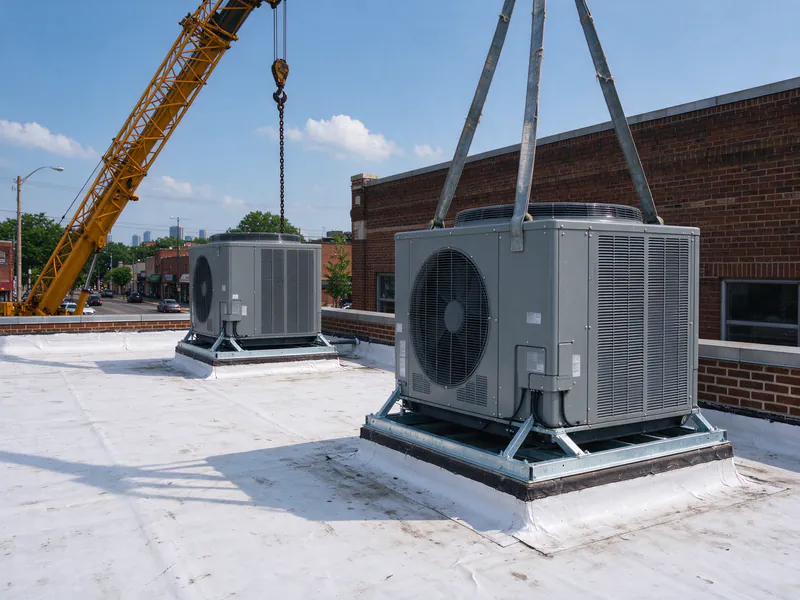
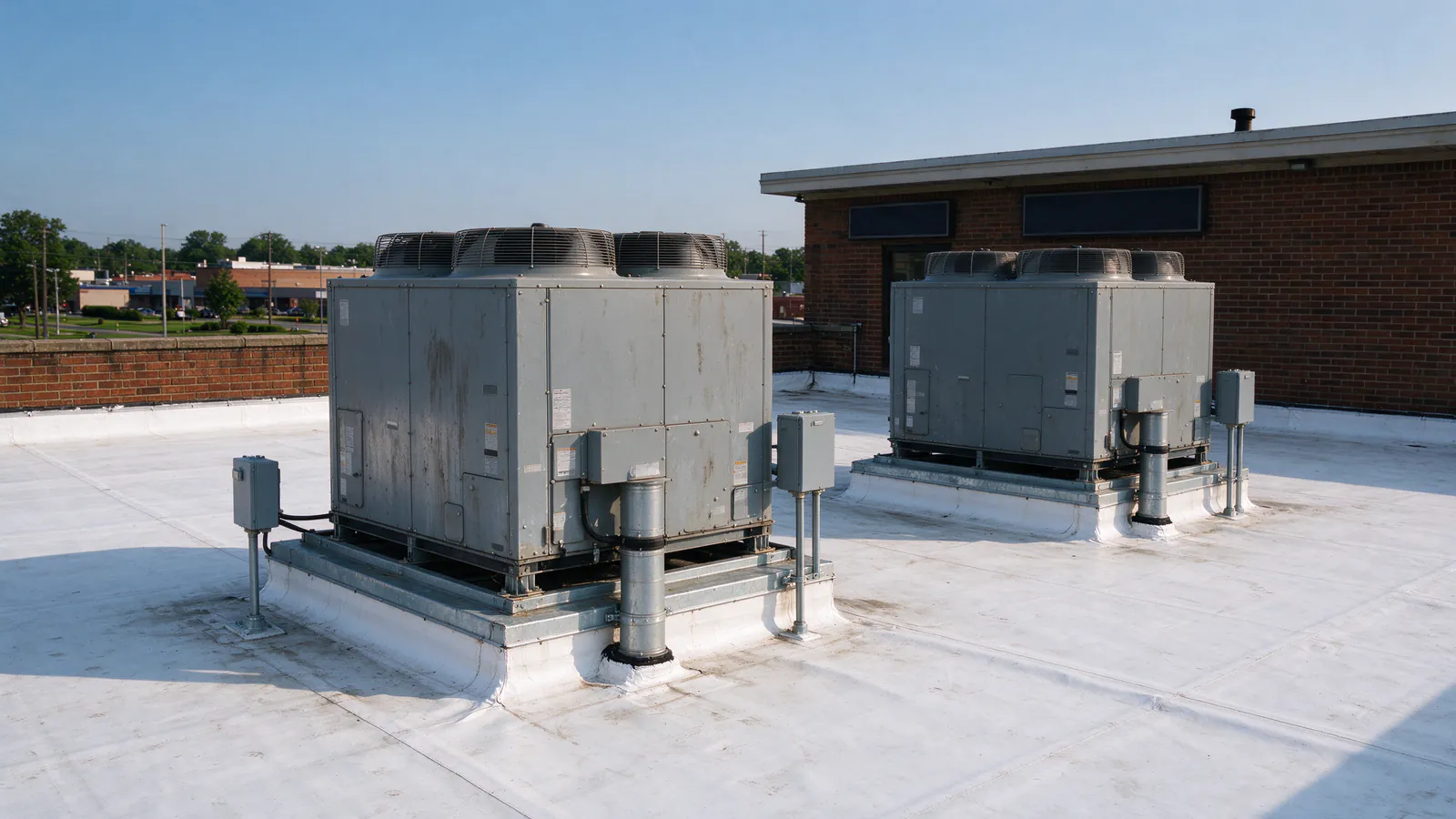
The whole system in one cabinet on the roof, sitting on a curb over the duct openings. Packaged units fit flat-roofed buildings where there is no room inside.
Many older buildings in Midtown and along commercial corridors run on 1980s or 1990s gas and electric packaged units, and a packaged heat pump can take their place on the same curb with an adapter.
Sizing for people and fresh air
Commercial loads aren’t sized like houses. Occupancy, lighting, equipment and outside air all count. A church sanctuary that is empty all week and full on Sunday needs a different answer from an office with steady staff.
We run a load calculation for each zone that includes the ventilation air the occupancy needs, and we look at how the space is used across the week. The sizing guide explains the basic method.
Zones and thermostats
Many small buildings have two or more units serving different areas. Each unit gets its own thermostat, and where the building is empty at night or on weekends, schedules save energy without anyone remembering to change a setpoint.
The lift, the permit and the street
A rooftop swap is a logistics job as much as an HVAC job.
- Measure the curbs and check the roof membrane around them.
- Book the crane and, on a street-front building, the street or sidewalk permit.
- Pull the commercial mechanical permit. In Memphis and unincorporated Shelby County that is the joint Office of Construction Code Enforcement.
- Cap the rooftop gas the evening before when gas packaged units come out.
- Lift early, remove the old units, set the adapters and the new units.
- Wire, start and test the same day, with the membrane patched at each curb.
The state license line
Tennessee requires a state contractor license for HVAC projects of $25,000 or more. Smaller jobs fall under local rules. The permit path for your building is part of the estimate.
Scheduling around your hours
We plan the sequence on the first visit with whoever controls the building, the owner, the manager or the church office. The usual patterns:
- Rooftop swaps on a Saturday, with gas capped Friday evening and the building running again by Monday.
- Inside work after hours for split systems in occupied offices.
- One unit at a time in buildings with several, so part of the space always has air.
A return check on the next business day, with people in the building, can be part of the plan, since airflow and thermostats behave differently in an occupied space.
Retiring rooftop gas
Many older packaged units burn gas for heat. Replacing them with packaged heat pumps removes the gas burner from the roof, along with its flue, its heat exchanger and the gas piping that runs up the wall.
What that changes for the building
- One less safety check. No heat exchanger to inspect for cracks and no flue on the roof.
- Simpler maintenance. Filters, coils and belts, without the combustion side.
- Backup heat. Packaged heat pumps carry electric strips for the coldest hours, sized to the zone’s load at Shelby County’s 20-degree design temperature.
On MLGW’s rates gas is cheaper per BTU than heat pump heat, so some owners keep gas packaged units where heating hours are long. We price both. The gas furnace or heat pump guide explains the running-cost side for houses; commercial accounts are on MLGW’s general service rates, so we run the numbers from your own bills.
Electrical and controls
Commercial units often run on three-phase power. We check the service, the existing disconnects and the breaker sizes against the new units’ ratings. Where a disconnect is rusted or undersized, a new one goes on the estimate.
The electrical guide covers the residential side; commercial service checks follow the same logic at a larger scale.
What it costs
Bluffline’s typical range for replacing a light commercial packaged unit is $9,000 to $22,000 per unit. Tonnage, the curb adapter, the crane and the roof all move the number.
Split systems are priced per job. Your written estimate after the visit sets the price, and the cost page lists every residential range for comparison.
What the estimate lists
- Units, tonnage and efficiency ratings for each zone.
- Curb adapters and any roof work.
- Crane, rigging and street permits.
- Gas capping, electrical and controls.
- The schedule and the permit.
Commissioning commercial units
Each unit gets the same proof as a house, plus the commercial items: outdoor air setting, economizer if present, and thermostat schedules.
The commissioning checklist covers the residential readings, and every unit’s numbers are written down for the building file.
Efficiency ratings
Packaged and split commercial heat pumps carry their own efficiency ratings. SEER2 and HSPF2 explained covers the residential scale; the estimate lists the rated efficiency for each unit we quote.
Duct problems in older buildings
Older storefronts often have ducts that were rearranged by several occupants. If a zone never cools, the ductwork page explains what we test, and the replacement page covers split systems in houses converted to offices.